Cambridge sits at roughly 300 meters above sea level along the Grand and Speed Rivers, where the valley walls expose a layered stratigraphy of silty clay over dense glacial till. Anyone excavating deeper than 3 meters near the Galt core or along the Highway 24 corridor quickly discovers that temporary shoring is not optional—it is a geotechnical necessity. The 2019 Mill Creek slope failure, though unrelated to anchors, underscored how quickly overconsolidated clay can lose strength once unloaded. For permanent retaining walls and braced cuts, the active and passive anchor design must account for long-term creep in the Queenston Shale bedrock and the high groundwater table that persists from March through May.
In Cambridge's overconsolidated clays, the difference between an active and a passive anchor is the difference between controlling deformation and reacting to it after movement has already occurred.
Scope of work in Cambridge Ontario
Critical ground factors in Cambridge Ontario
Anchor performance in the Hespeler Road commercial zone versus the Blair Village residential slope often differs dramatically, even when the design load is identical. Hespeler Road sits on a thicker sequence of sandy silt lenses within the till, which can cause grout loss during installation and reduce the effective bond diameter if not compensated with controlled re-grouting. Blair Village, perched above the Grand River valley, contends with perched groundwater and weathered shale at depths as shallow as 4 meters—anchors drilled into this transition zone without a thorough in-situ permeability assessment risk developing a hydraulic connection between the anchor borehole and the slope face, accelerating corrosion and reducing the service life below the 75-year threshold required for permanent structures under the Ontario Building Code.
Our services
Anchor design for Cambridge projects typically falls into two service categories, depending on whether the excavation is temporary or permanent and whether the anchor must actively control movement from day one:
Active Prestressed Anchor Systems
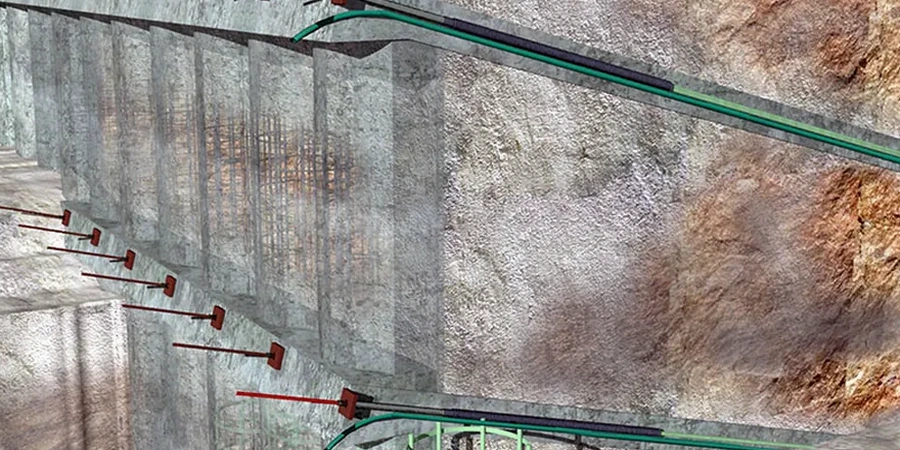
Designed for permanent retaining structures and deep basement excavations where lateral displacement must be limited to less than 15 mm. Each anchor is stressed to 80-100% of the design load, locked off, and protected with double-corrosion encapsulation. Suitability and proof testing on sacrificial anchors confirm the ultimate bond capacity before production drilling begins.
Passive Anchor and Tieback Analysis
Applied in temporary shoring cuts and rock slope stabilization where controlled deformation is acceptable. The anchor engages only as the retained soil mass moves toward the cut, making accurate estimation of the active wedge geometry—using Spencer or Morgenstern-Price limit equilibrium methods—critical to setting the unbonded length. This approach reduces cost while maintaining a factor of safety above 1.5 for temporary works.
Common questions
How much does an active anchor system cost per anchor in Cambridge?
For projects in Cambridge, the installed cost per active anchor typically ranges from CA$1,220 to CA$4,830, depending on the bonded length in till or bedrock, the corrosion protection class required, and whether post-grouting is specified. Permanent double-corrosion-protected anchors fall at the upper end of this range.
What is the difference between a proof test and a performance test for anchors?
A proof test is performed on production anchors to confirm they meet the design acceptance criteria—typically loaded to 133% of the design load and held for 10 minutes while measuring creep. A performance test is conducted on sacrificial test anchors before production begins, loading in increments up to failure or 200% of design load, to verify the ultimate bond stress used in the design.
How deep must the unbonded length extend in Cambridge's soil conditions?
The unbonded length must place the bond zone entirely beyond the theoretical active failure wedge. In Cambridge's silty clay and till, this typically translates to a minimum unbonded length of 4.5 to 6.0 meters, though slope geometries near the Grand River valley or the 401 corridor often require 7.0 meters or more once the wedge is modeled with site-specific shear strength parameters.