In Cambridge, the subgrade beneath a new industrial park in the North Galt expansion area often tells a different story than the topsoil suggests. We see this routinely at the lab: samples arriving with visible sand lenses, silt pockets, and occasional clay balls that make moisture conditioning critical before the plunger ever touches the specimen. The laboratory CBR test gives you a direct measurement of the soil's resistance to penetration, simulating the long-term stress from wheel loads on a pavement structure. It is not a proxy test—it is the empirical backbone of flexible pavement design per the AASHTO 1993 method. For cohesive tills common in Waterloo Region, we typically run the soaked condition over 96 hours to mimic spring-thaw saturation, combining the result with Proctor density data to confirm that the contractor's compaction target actually delivers the design CBR at field moisture. When granular borrow is specified, we also cross-check the soaked CBR against grain-size distribution to flag fines migration risk before the asphalt goes down.
A soaked CBR value is not a soil property—it is a pavement performance prediction. In Cambridge tills, the difference between as-compacted and soaked CBR can exceed 70%.
Scope of work in Cambridge Ontario
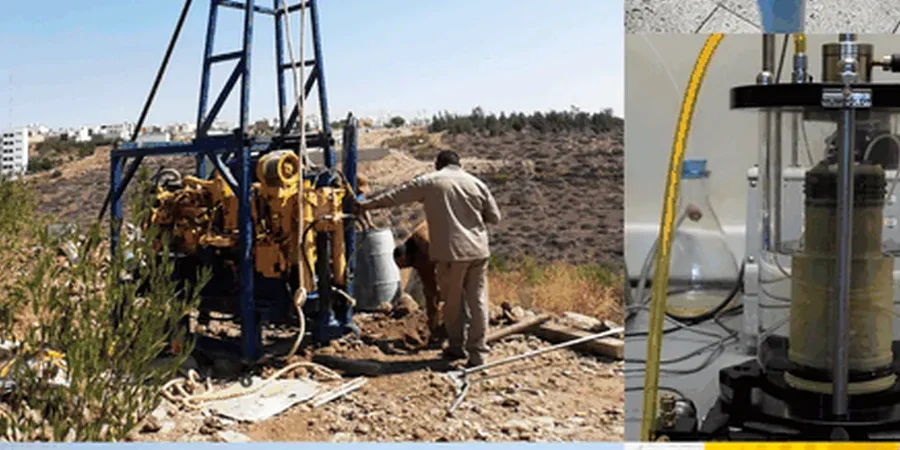
Critical ground factors in Cambridge Ontario
Cambridge sits on a complex glacial stratigraphy where the Halton Till, Port Stanley Till, and occasional glaciofluvial outwash deposits interlock within short distances. A CBR test run without the full four-day soak—or worse, run only on an unsoaked specimen—will overestimate the subgrade strength by a factor of two or three in silty zones. The risk compounds when a pavement design relies on a single CBR value from a borrow source that varies with depth; we have seen projects on Townline Road where the upper till yielded CBR 12% and the lower stratified silt, just 40 cm deeper, dropped to 3%. That is enough to trigger reflective cracking in the asphalt within the first winter. The laboratory CBR does not substitute for field compaction control, but it does establish the target density and moisture envelope that the field crew must hit. Skipping the swell measurement is another common pitfall: a till that swells 4% under a rigid pavement slab can lift the slab corners and create faulting at the joints, a problem visible on several older commercial plazas along Hespeler Road.
Our services
Our Cambridge geotechnical laboratory handles the full CBR workflow from sample extrusion to final report, typically within four working days after the soaking period ends. Each test package includes pre- and post-soak moisture content, density verification, swell data, and the corrected CBR curve. We work with local consulting firms, paving contractors, and municipal inspectors who need defensible numbers for MTO or Regional subgrade acceptance.
Standard Soaked CBR (ASTM D1883)
Three-point compaction curve plus CBR mold at optimum moisture, 96-hour soak, swell monitoring, and penetration test. Report includes stress-penetration curve, corrected CBR at 0.1 in and 0.2 in, and dry density.
Unsoaked CBR for Granular Base
For Granular A and Granular B base materials where drainage prevents saturation. Compacted at optimum moisture, tested immediately without soaking. Useful for construction QA/QC verification against OPSS 1010 specifications.
CBR Correlation Package
Combined CBR, grain-size analysis, and Atterberg limits on the same sample to correlate CBR with fines content and plasticity index. Helps predict CBR variability across a borrow pit or subdivision without running CBR on every lift.
Common questions
How much does a laboratory CBR test cost in Cambridge?
A single-point soaked CBR test per ASTM D1883 typically ranges from CA$170 to CA$290, depending on whether you need the full compaction curve, the number of specimens, and the turnaround time. Rush results within two days of soak completion add a surcharge. We recommend requesting a written quote that includes moisture content, density, swell, and the CBR report so there are no surprises on the invoice.
Why does the sample need to soak for four days?
The 96-hour soak per ASTM D1883 simulates the worst-case moisture condition a subgrade will see during spring thaw, when the water table rises and the pavement traps moisture underneath. In Cambridge's silty tills, the soaked CBR can be less than half the unsoaked value. Shortening the soak period gives a falsely optimistic CBR and risks under-designing the pavement structure.
Can you test CBR on aggregate base materials?
Yes, we run CBR on Granular A, Granular B, and other coarse aggregates using the same ASTM D1883 procedure. Because free-draining aggregates do not hold water the way a silt does, we typically run them unsoaked or with a shorter soak, following the Ontario Provincial Standard OPSS 1010. We also verify the gradation first to ensure the maximum particle size fits within the 6-inch mold.
What is the difference between field CBR and laboratory CBR?
Field CBR, often measured with a Dynamic Cone Penetrometer or a field CBR apparatus, gives a quick in-situ indication of strength but cannot control moisture or density the way a lab test can. Laboratory CBR is the reference method: we compact the soil at a known moisture and density, soak it under controlled conditions, and measure penetration with calibrated equipment. The lab value is what the pavement design uses directly; field CBR is a correlation tool for construction verification.
How do I prepare a soil sample for CBR testing?
For a laboratory CBR, we need about 30 kg of representative soil in sealed plastic bags to prevent moisture loss. The sample should come from the subgrade elevation, not the topsoil. If you are sampling from a test pit or borehole, label the bag with the project name, station, depth, and date. Keep the sample cool and deliver it to the lab within 24 hours. We can also arrange pickup in Cambridge, Kitchener, and surrounding Waterloo Region.