A six-storey residential development near the Speed River encountered organic silts at 2.5 metres depth — classic Grand River valley stratigraphy that makes conventional footings uneconomical in Cambridge Ontario. The geotechnical investigation confirmed 6 metres of compressible material overlying dense till, and the structural loads required a ground improvement approach rather than deep foundations. We designed a grid of 700 mm diameter stone columns installed by wet top-feed vibro-replacement, achieving a composite friction angle above 38 degrees and reducing differential settlement to less than 15 mm under the design load. For projects like this, the decision to use stone columns rather than driven piles often comes down to schedule and cost, but the technical justification depends entirely on the quality of the in-situ permeability testing and consolidation parameters measured in the lab before the design phase begins.
Stone columns increase the composite friction angle of treated ground from less than 25 degrees to over 38 degrees, transforming liquefiable or compressible soils into competent foundation material.
Scope of work in Cambridge Ontario
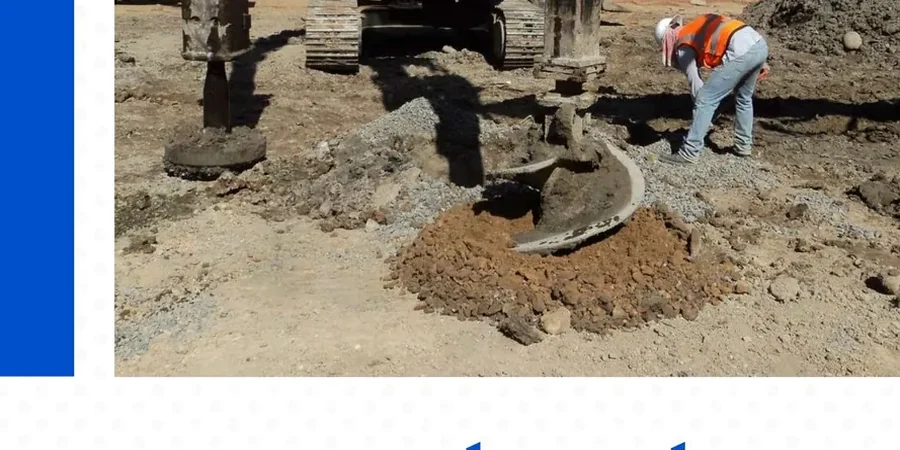
Critical ground factors in Cambridge Ontario
Cambridge Ontario sits at approximately 330 metres above sea level on the glacial outwash deposits of the Grand River watershed, where the water table is typically within 2 metres of the surface from March through November. This high groundwater condition creates two risks for stone column design: first, the vibro-replacement process can generate excess pore pressures in low-permeability silts, temporarily reducing the strength of the surrounding soil during installation; second, if the drainage function of the columns is not properly integrated into the site grading plan, post-construction pore pressure equalisation can cause heave or softening of floor slabs. The 2020 Cambridge flood event, which saw the Speed River rise 2.1 metres above normal levels in 48 hours, highlighted the importance of designing stone columns as both a structural and a drainage element — columns that terminate in a permeable working platform perform far better under rapid groundwater fluctuation than those capped with low-permeability fill.
Our services
Our Cambridge Ontario ground improvement team provides two integrated service packages that cover the full project lifecycle from feasibility through construction quality assurance.
Stone Column Design Package
Complete design deliverable including Priebe method calculations, PLAXIS 2D numerical modelling for settlement and bearing capacity, area replacement ratio optimisation, load transfer platform design with geogrid specification, and column layout drawings keyed to the structural grid. We provide the sealed design report required for Cambridge Ontario building permit submissions.
Construction QA/QC & Post-Treatment Verification
On-site quality control during vibro-replacement installation, including real-time monitoring of amperage and penetration rate, post-installation CPT or SPT verification testing, and plate load tests on representative columns to confirm the achieved deformation modulus meets the design assumptions.
Common questions
What are the typical costs for stone column design and installation in Cambridge Ontario?
For a typical Cambridge Ontario project, the stone column design package including numerical modelling and sealed drawings ranges from CA$2,080 to CA$7,290 depending on site complexity and the number of column layout configurations required. Installation costs are separate and depend on depth, diameter, and access conditions.
How does stone column design differ from vibrocompaction for Cambridge Ontario soils?
Stone columns add material to displace and reinforce soft cohesive soils, while vibrocompaction densifies granular soils through vibration alone. In Cambridge Ontario, where Grand River floodplain deposits often contain interbedded silts and clays with less than 10% fines, we sometimes specify stone columns for the cohesive layers and vibrocompaction for the granular zones within the same site.
How do you verify that installed stone columns meet the design requirements?
We specify post-installation CPT soundings through the centre of selected columns, comparing the cone resistance profile against the design target. For critical structures, we also perform plate load tests on isolated columns to directly measure the load-settlement response and confirm the deformation modulus used in the settlement analysis.
What minimum soil strength is required for stone column installation?
The generally accepted minimum undrained shear strength is 15 kPa for wet top-feed vibro-replacement. Below this threshold, the soil cannot provide sufficient lateral confinement during column construction, and the column diameter becomes unpredictable. In Cambridge Ontario lacustrine clays approaching this limit, we often recommend a pre-treatment phase using staged loading or wick drains before column installation.
Can stone columns be used for liquefaction mitigation in Cambridge Ontario?
Yes, stone columns provide both densification of the surrounding soil and drainage paths for excess pore pressure dissipation during seismic events. For Cambridge Ontario sites within the NBCC seismic hazard zone for southern Ontario, we design the column grid spacing to achieve the target improvement factor for liquefaction resistance, typically verified through post-treatment SPT or CPT testing to confirm the increase in blow count or cone resistance.