The Grand River cut through Cambridge leaving behind a complex patchwork of glacial till, lacustrine clay, and outwash sand that makes every site its own puzzle. Beneath the neighborhoods of Galt, Preston, and Hespeler, the near-surface soils shift from stiff silty clay to lean plastic deposits within a single block, and that variability is exactly why the city's geotechnical consultants rely on Atterberg limits testing before committing to a foundation elevation. With a seasonal groundwater table that fluctuates sharply in the low-lying areas near the Speed River confluence, classifying the fines content isn't optional—it's the difference between a footing that drains and one that traps moisture through freeze-thaw cycles. Our laboratory runs the full ASTM D4318 suite on every sample, so the liquid limit, plastic limit, and resulting plasticity index give the design team a clear picture of how the soil will behave when it gets wet, which in Cambridge happens more often than the bedrock maps suggest.
A clay that changes from stiff to plastic with a few percent moisture shift can turn a textbook footing design into a settlement problem before the slab is poured.
Scope of work in Cambridge Ontario
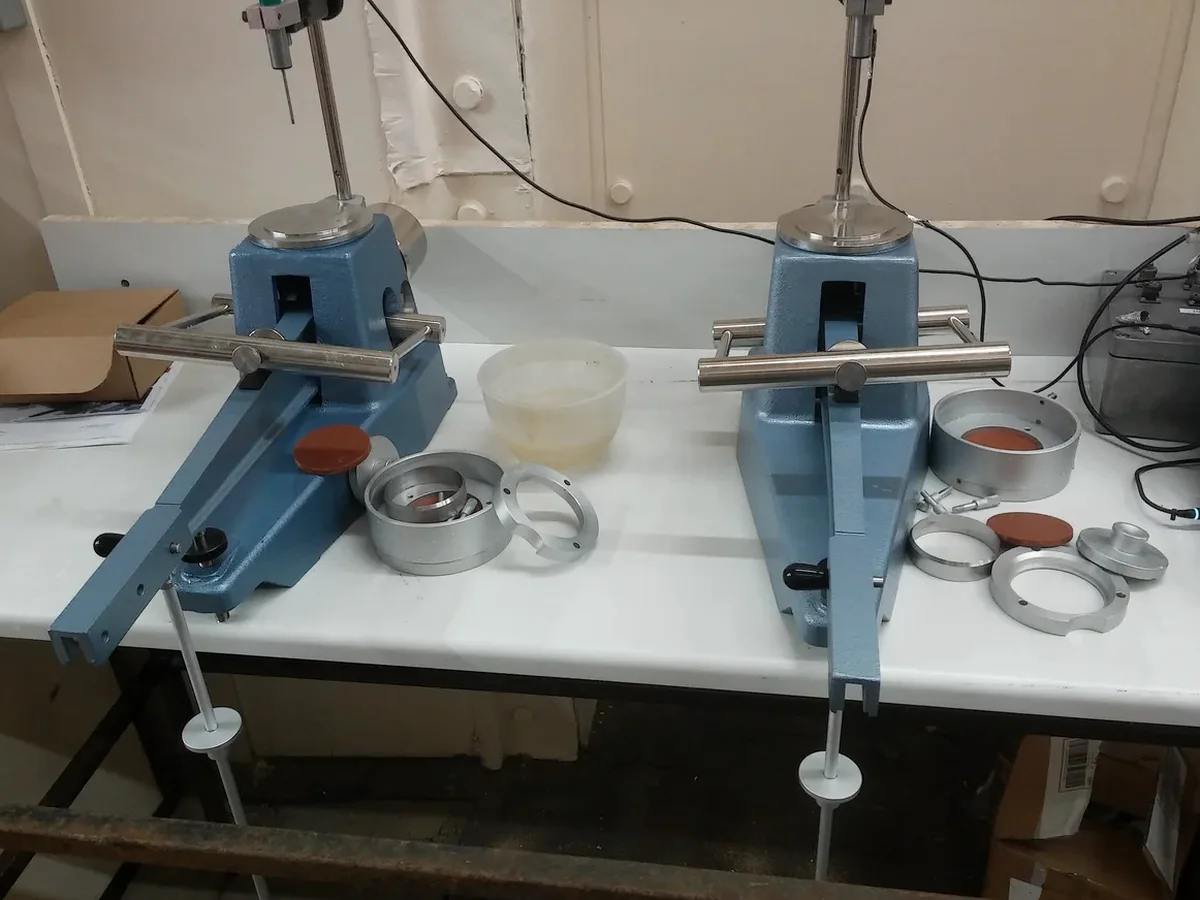
Critical ground factors in Cambridge Ontario
Cambridge sits at roughly 330 meters elevation where the glacial stratigraphy creates perched water tables that keep foundation clays saturated well into the construction season. When a contractor excavates to bearing grade and finds material that crumbles in the hand but smears under a trowel, the plasticity index becomes the single most useful number on the lab report. High-plasticity clays in the CH zone can undergo volume changes of 10 percent or more between dry summer conditions and spring saturation, which translates to differential movement that cracks masonry and binds doors in low-rise residential construction. The Ontario Building Code references the Atterberg limits indirectly through its reliance on USCS classification for foundation design, and municipal reviewers in the Region of Waterloo increasingly ask for the plasticity index when expansive soil is suspected. Without that data point the default assumption is often a more conservative bearing pressure, which means a wider footing, more concrete, and a longer forming schedule that eats into the project margin.
Our services
The Atterberg limits test works best when paired with complementary index testing that builds a complete geotechnical profile for the site. These are the two services most frequently requested alongside plasticity testing on Cambridge projects.
Grain Size Analysis by Sieve and Hydrometer
Combined ASTM D6913 and D7928 testing that quantifies the full particle-size distribution from coarse sand through colloids. When the Atterberg limits classify a soil as fat clay, the hydrometer curve reveals whether the plasticity is driven by true clay minerals or by silt with organic content—a distinction that affects both the compaction curve and the drainage design.
Standard Proctor Compaction Testing
ASTM D698 moisture-density relationship determination using the standard effort. The optimum moisture content from the Proctor curve is compared directly against the plastic limit to establish an acceptable compaction moisture range, which lets the site supervisor adjust water addition on the fly without risking overcompaction in the plastic zone.
Common questions
How much does Atterberg limits testing cost for a Cambridge project?
The fee for a complete set—liquid limit, plastic limit, and plasticity index on one sample—runs between CA$90 and CA$150 depending on whether the sample needs pretreatment or multiple-point liquid limit determination. Bulk pricing applies when more than ten samples are submitted from the same site investigation.
What sample condition is required for reliable liquid and plastic limit results?
The sample must be moist and undisturbed, sealed immediately after extraction to prevent moisture loss. We need a minimum of 200 grams of material passing the No. 40 sieve, free of organic matter or debris. Dried-out or contaminated samples produce liquid limit values that can deviate by 5-8 percentage points from in situ behavior, which is enough to misclassify a CL soil as ML on the plasticity chart.
Can the Atterberg limits predict whether a Cambridge clay will shrink or swell under a slab?
The plasticity index is the primary indicator. Soils with a PI above 25 typically exhibit moderate to high expansion potential, and values exceeding 35 correlate strongly with problematic shrink-swell behavior in the regional glacial clays. The test does not directly measure volume change, but when combined with the liquid limit it provides a reliable screening tool that determines whether a swell-consolidation test or suction measurement is warranted before finalizing the foundation depth. More info.