Cambridge sits on a complex glacial stratigraphy. The Grand River carved through silty clay and loose till, leaving deposits that challenge any underground excavation. We have seen borehole logs from Hespeler Road where the undrained shear strength drops below 30 kPa at just 6 metres depth. That is the reality of tunneling here. Before a TBM cutterhead touches the face, the ground needs to be understood. Our geotechnical analysis for soft soil tunnels combines lab testing, in-situ data, and numerical modeling to define the excavation sequence and support pressures. When the stratigraphy includes interbedded sand lenses, we also recommend a CPT test to map the transitions with continuous data, which standard SPT alone cannot resolve.
In Cambridge silts, face pressure is not a suggestion. It is the difference between a controlled excavation and a sinkhole on Coronation Boulevard.
Scope of work in Cambridge Ontario
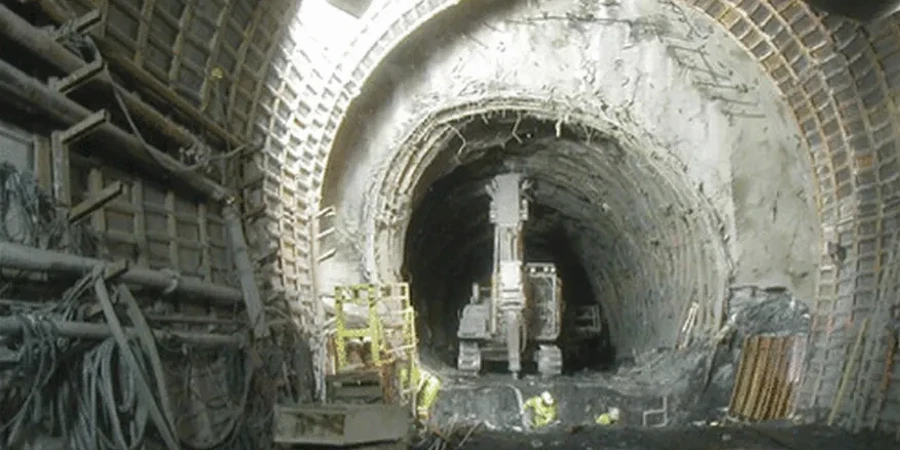
Field demonstration
Critical ground factors in Cambridge Ontario
The most common mistake we see in Cambridge is assuming a uniform clay profile. A contractor drills five boreholes, finds stiff till, and sets the TBM parameters for a medium-stiff ground. Then the machine hits a buried channel filled with soft organic silt at Franklin Boulevard. Face loss occurs. The ground moves upward. Within hours, there is a depression behind a warehouse. We prevent this by mapping the stratigraphic boundaries with geophysics before the drive begins. Seismic refraction or resistivity surveys can trace the paleochannel edges between boreholes. The analysis then defines variable face pressure zones along the alignment. Ignoring those transitions is not a risk, it is a guarantee of over-excavation and settlement claims. In urban tunneling, the cost of a single surface collapse far exceeds the investment in a thorough geotechnical analysis.
Our services
We deliver a complete soft-ground tunnel analysis package. Every project starts with a ground model, moves to parameter selection, and ends with a verified design envelope. Our lab in the region runs the full suite of ASTM tests.
TBM Face Pressure & Settlement Analysis
We calculate the required EPB face pressure profile along the tunnel alignment using limit equilibrium and finite element methods. Outputs include transverse settlement troughs, longitudinal deflection curves, and a risk register for each chainage.
Squeezing Ground & Liner Design
For silty clays with low overconsolidation, we evaluate long-term convergence using the convergence-confinement method. We specify the shotcrete thickness, steel set spacing, and final lining reinforcement based on the predicted ground loads.
Common questions
What ground conditions in Cambridge require an EPB tunnel boring machine?
The silty clay deposits along the Grand River valley have low undrained shear strength and high groundwater. An open-face shield would risk face instability. We specify Earth Pressure Balance (EPB) TBMs because the pressurized cutterhead chamber can balance the hydrostatic and earth pressures at the face. Our analysis determines the exact pressure range needed for each section of the drive.
How do you predict surface settlement before tunneling starts?
We build a 2D or 3D finite element model using the hardening soil constitutive model. We input lab data from triaxial and consolidation tests, then simulate the volume loss at the face and along the shield. The model outputs a settlement trough that we calibrate against empirical methods like Peck (1969). This gives the contractor a clear envelope for protecting buildings and utilities.
What is the typical timeline for a soft-ground tunnel analysis in Cambridge?
A complete analysis, from site investigation review to the final geotechnical design report, usually takes 4 to 6 weeks. The critical path is the lab testing program. Consolidation tests need 10 to 14 days per load increment. We can often overlap the early modeling phases with the lab work to keep the project moving.
What is the cost range for this type of geotechnical analysis?
The fee depends on the tunnel length, the number of soil units, and the complexity of the surface structures above. For a typical Cambridge project, the analysis package ranges from CA$6,160 to CA$23,290. A longer tunnel with multiple cross-passages and sensitive adjacent buildings will be at the higher end of that range.
Can you analyze a tunnel alignment under existing industrial buildings near the 401?
Yes. We model the building loads as surcharge on the ground surface and include the foundation stiffness in the finite element mesh. The analysis checks if the induced settlements exceed the angular distortion limits for the structure. If they do, we recommend compensation grouting or a stiffer lining section to reduce ground movements.