A recent residential development near the Grand River in Cambridge required a 4.2-meter cantilever wall to manage a steep grade change between two phases of construction. The site sat on a mix of silty clay and discontinuous sand lenses, typical of the Haldimand clay plain deposits found throughout the region. The design team faced immediate questions about short-term excavation stability and long-term drainage behind the wall. In Cambridge, retaining wall design must account for more than just lateral earth pressure. Seasonal frost action reaches 1.2 meters depth, and the water table fluctuates significantly between spring melt and late summer. A test pit investigation on the adjacent lot had already revealed softened clay at 2.8 meters depth, which influenced the decision to extend the wall footing deeper than originally planned. The city's building department required a stamped submission demonstrating compliance with the Ontario Building Code and NBCC 2020 structural provisions before issuing the foundation permit.
In Cambridge, the difference between a successful retaining wall and a failing one often comes down to drainage design and accurate assessment of the native till's undrained shear strength.
Scope of work in Cambridge Ontario
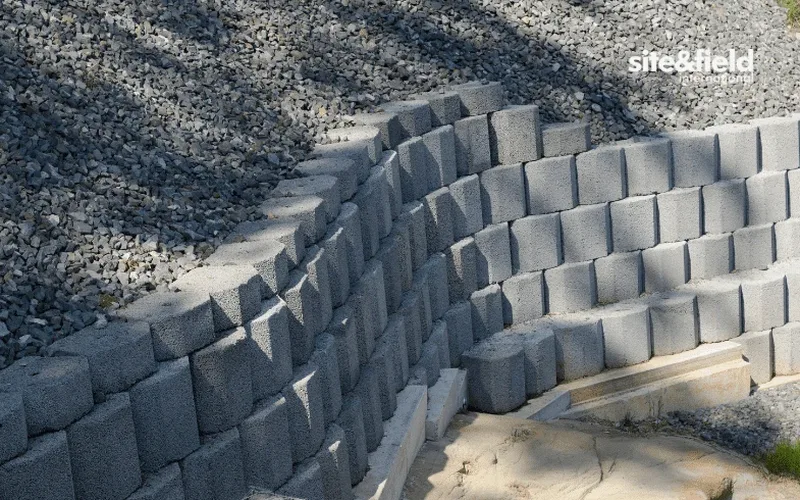
Field demonstration
Critical ground factors in Cambridge Ontario
The risk profile for retaining walls in Cambridge splits sharply between the eastern and western sides of the Grand River. On the west side, through Blair and near the Dumfries Conservation Area, the overburden is predominantly dense till over limestone bedrock at shallow depth. Wall foundations here are straightforward, provided the till is not disturbed during excavation. On the east side, particularly in the Hespeler area and along the Speed River floodplain, the soil column often includes 3 to 5 meters of compressible organic silt and soft clay overlying the till. A wall built without recognizing this soft layer can experience differential settlement, tilting, or even bearing capacity failure. The Speed River's seasonal fluctuations introduce additional hydrostatic pressure behind walls within the flood fringe zone, which the Grand River Conservation Authority regulates. Undrained loading conditions during construction, before drainage systems become fully effective, frequently govern the design of the wall stem and heel. Our approach includes a detailed review of the borehole logs for any indication of varved clay layers, which can act as preferential slip surfaces. For walls retaining cut slopes in these sensitive silts, we specify staged excavation and immediate placement of the drainage blanket to prevent strength loss from moisture infiltration.
Our services
Retaining wall design services in Cambridge cover the full project lifecycle, from feasibility assessment through construction review. Each package is tailored to the local soil conditions and regulatory requirements.
Cantilever and Gravity Wall Design
Complete structural and geotechnical design of reinforced concrete cantilever walls, gravity walls, and segmental block systems. Includes bearing capacity checks, overturning and sliding stability, global slope assessment, and drainage detailing per OBC and local conservation authority requirements.
MSE Wall and Hybrid Systems
Design of mechanically stabilized earth walls for highway embankments, commercial site grading, and bridge approaches. We specify reinforcement length, vertical spacing, and facing type based on site-specific backfill properties and the critical failure surface geometry.
Condition Assessment and Remedial Design
Evaluation of existing retaining walls showing distress: cracking, tilting, efflorescence, or drainage failure. The service includes a site inspection, review of original construction records, forensic soil investigation if required, and development of repair or replacement designs.
Common questions
How deep does the footing need to be for a retaining wall in Cambridge?
The Ontario Building Code mandates a minimum footing depth of 1.2 meters below finished grade to protect against frost heave in the Cambridge area. However, the actual depth is determined by the bearing stratum and the wall height. If the competent bearing layer — typically undisturbed Halton Till — is deeper than 1.2 meters, the footing must extend down to that layer. For walls over 2.5 meters on soft clay sites in the Hespeler area, footing depths of 1.8 to 2.4 meters are not unusual.
What is the typical cost range for a retaining wall design in Cambridge?
Professional design fees for a retaining wall in Cambridge typically range from CA$1,530 to CA$5,310, depending on wall height, complexity, and whether a full geotechnical investigation is included. A straightforward 1.5-meter segmental block wall on a residential lot falls at the lower end. A 5-meter reinforced concrete wall requiring slope stability analysis, conservation authority review, and construction-phase monitoring falls at the upper end.
Do I need a building permit for a retaining wall in Cambridge?
Yes, the City of Cambridge requires a building permit for retaining walls greater than 1.0 meter in height, measured from the base of the footing to the top of the wall. Walls supporting a surcharge, such as a driveway or building, require a permit regardless of height. The application must include stamped structural and geotechnical drawings and a drainage plan.
What type of backfill material is recommended behind retaining walls in this region?
We specify free-draining granular material meeting OPSS 1010 Granular B Type I or equivalent, with less than 8 percent passing the 75-micron sieve. The native till excavated on site in Cambridge contains too much silt and clay for use as structural backfill — it retains water and develops excessive lateral pressure during freeze-thaw cycles. A minimum 300 mm wide drainage blanket directly behind the wall stem is standard, with a perforated collector pipe at the base.
How do you address the Grand River Conservation Authority regulations for walls near the floodplain?
For any retaining wall within the regulated flood fringe of the Grand or Speed Rivers, we coordinate directly with the GRCA during the design phase. The wall must not obstruct flood flows or increase upstream flood levels. Foundation elements may require scour protection, and the design must account for saturated soil conditions and rapid drawdown scenarios. The GRCA review process runs parallel to the city building permit application.