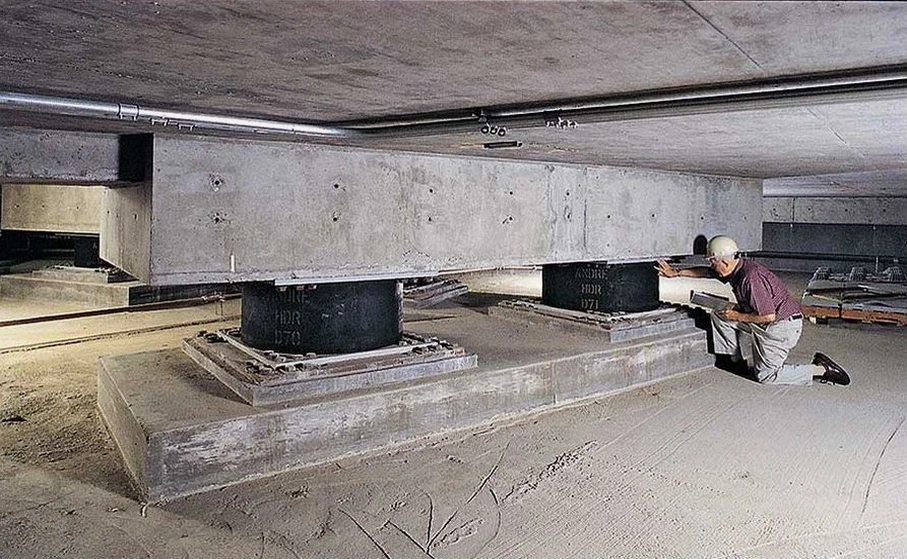
The elastomeric bearings arrive on a flatbed, each unit weighing over a ton. In Cambridge, where the glacial till meets the dolostone of the Niagara Escarpment, installing these isolators requires precision. We position them between the foundation and the superstructure, decoupling the building from ground motion. The 2015 National Building Code (NBCC) assigns Cambridge a Site Class C or D depending on depth to bedrock, and the spectral acceleration values here demand a rigorous isolation strategy. For projects near the Speed River, where soft alluvium overlies the till, we often run a seismic refraction survey first to map the bedrock profile before finalizing the isolator layout. This isn't a generic solution. It's a system tuned to the specific stratigraphy of Waterloo Region.
A well-designed base isolation system can reduce seismic forces on the superstructure by more than half compared to a fixed-base design in Cambridge soil conditions.
Scope of work in Cambridge Ontario
Critical ground factors in Cambridge Ontario
The risk profile changes between East Galt and Hespeler. East Galt, closer to the Speed River, has thicker compressible clay lenses. Hespeler sits on stiffer till over dolostone. A building on the east side without isolation will experience higher spectral displacement during a design-basis earthquake. The 2015 NBCC uniform hazard spectrum for Cambridge peaks near 0.2 seconds. A fixed-base structure on soft soil resonates right there. Base isolation pulls the period out of that hazard zone entirely. The bigger risk is ignoring soil-structure interaction. We've seen cases where a contractor assumes firm ground everywhere, only to hit saturated silt at three meters. That's when you need the isolators to handle differential settlement and rotation, not just lateral displacement.
Our services
Our base isolation scope in Cambridge covers the full design chain from feasibility to commissioning. Every project starts with the geotechnical data. We don't run the design in a vacuum.
Isolator Selection and Nonlinear Modeling
Bilinear and Bouc-Wen hysteretic models calibrated to prototype test data. We run response history analyses using site-specific ground motions matched to the Cambridge NBCC spectrum.
Full-Scale Prototype Testing Oversight
We specify the test protocol, witness the production testing at the manufacturer's facility, and review load-displacement loops for conformance to CSA A23.3.
Construction Support and Inspection
On-site verification of isolator placement, leveling, and bolting. We inspect the moat wall clearance and utility connections to ensure the isolation gap remains unobstructed.
Common questions
What does base isolation design cost for a mid-rise building in Cambridge?
For a typical three- to six-story commercial or institutional building in Cambridge, the full design scope—including nonlinear modeling, isolator specification, prototype testing oversight, and construction support—ranges from CA$6,350 to CA$11,860. The final figure depends on the number of isolator types, the complexity of the superstructure, and whether time-history analysis is required.
Is base isolation mandatory under the Ontario Building Code?
Not mandatory for all structures, but the Ontario Building Code references the NBCC 2015, which permits base isolation as an alternative to conventional force-based design. For post-disaster buildings, hospitals, and high-importance structures, isolation often becomes the most cost-effective path to meet the enhanced performance objectives.
How do you verify the isolators will perform during a real earthquake?
Every isolator prototype undergoes full-scale testing per CSA A23.3 Annex A. The test sequence includes three fully reversed cycles at design displacement, plus a maximum considered earthquake cycle. We verify the effective stiffness and damping fall within the acceptance bounds before approving production.
Can you retrofit an existing building with base isolation in Cambridge?
Yes, though it requires temporary jacking of the structure to cut columns and insert isolators. We've done this on heritage masonry buildings and concrete frame structures. The process demands careful sequencing—load transfer, column cutting, isolator installation, and release—all monitored with real-time displacement sensors.