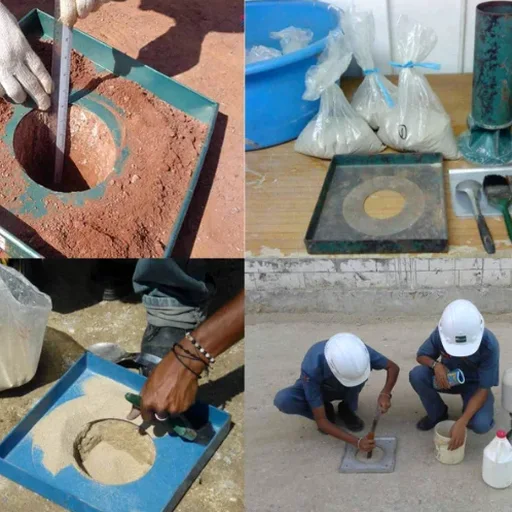
Cambridge, with its 145,000 residents and a 35-meter elevation drop from the Puslinch moraine down to the Grand River floodplain, presents a patchwork of compacted glacial till and softer alluvial deposits. Settlement here is a genuine concern, not a theoretical one. Every cubic meter of engineered fill placed in subdivisions near Hespeler or beneath warehouse slabs in the Maple Grove industrial corridor requires verification that it can carry design loads without differential movement. The sand cone test (ASTM D1556) provides that direct field measurement of in-place density, correlating compaction effort with a quantifiable result. For projects under CSA A23.3 oversight, we pair this test with Proctor curves developed in our lab to establish the target maximum dry density specific to the on-site material. The process is straightforward—excavate a small hole, recover all soil, weigh it, fill the cavity with calibrated Ottawa sand—but the interpretation requires understanding Cambridge's variable moisture regimes, especially in clay-rich tills that can pass a nuclear gauge but still hold excess pore pressure.
Direct mass-volume measurement eliminates the material composition variables that can distort indirect density readings in Cambridge's mixed glacial soils.
Scope of work in Cambridge Ontario
Critical ground factors in Cambridge Ontario
NBCC 2015, enforced through the Ontario Building Code, mandates soil bearing verification beneath footings, and the Cambridge supplement extends this to compaction testing of engineered fill under floor slabs where loose backfill against foundation walls can create a perched water trap. The most frequent non-compliance scenario we observe involves clayey silt fill placed wet of optimum during a rainy week in October or April, when the Grand River valley sees elevated groundwater. The sand cone test reads acceptable density, but the material consolidates over the following winter under slab-on-grade loading, opening a 15–25 mm gap under interior partition walls. The Ontario Building Code's reference to CSA A23.3 and the MTO's granular base specifications makes a defensible density record part of the warranty file. Without it, a contractor carries liability for differential settlement claims that can surface two full seasonal cycles after substantial completion. Cambridge building inspectors now routinely request sand cone logs stamped by a laboratory holding ISO 17025 accreditation, which provides third-party traceability on the calibration of scales and sand cones used in the field.
Our services
Our Cambridge field crews deploy the sand cone kit alongside laboratory Proctor correlation to deliver a complete compaction verification package. Each test location is documented with GPS coordinates, lift elevation, and a photo record for the project file.
In-Place Density by Sand Cone (ASTM D1556)
Direct density measurement on compacted fill, subgrade, and granular base layers. Includes excavation, sample recovery, calibrated sand volume replacement, and immediate calculation of wet density and percent compaction against the laboratory Proctor target. Suitable for particle sizes up to 38 mm.
Compaction Curve Correlation (Proctor)
Laboratory determination of maximum dry density and optimum moisture content per ASTM D698 or D1557, using material sampled from the actual fill source. The Proctor curve is the mandatory reference for interpreting sand cone field results and is required by Cambridge permit conditions for structural fill placement.
Common questions
What does a field density test with the sand cone method cost in the Cambridge area?
A single sand cone test, including the Proctor laboratory curve correlation, typically ranges from CA$150 to CA$220 depending on the number of tests per day and site access. Projects with multiple lifts or larger test grids benefit from a reduced per-point rate.
When do Cambridge building inspectors require sand cone tests instead of a nuclear gauge?
Inspectors often specify the sand cone method for trench backfill under municipal road allowances, for structural fill beneath raft slabs in the floodplain, and whenever the fill contains magnetite-bearing aggregate that can bias nuclear gauge readings. The sand cone provides a direct physical measurement that is simpler to audit.
How deep does a sand cone test evaluate, and what material size limits apply?
The standard sand cone test evaluates the top 100 to 150 mm of a compacted lift. The method is valid for soils with a maximum particle size around 38 mm. When the fill contains larger cobbles, we combine the test with a replacement technique or recommend a test pit density determination.
How many sand cone tests are typically required for a commercial building pad in Cambridge?
Cambridge permit conditions generally require a minimum of one test per lift per 200 square meters of building footprint, with additional tests at the perimeter near foundation walls where compaction is harder to achieve. A 1,000 m² single-story commercial pad with three lifts would typically need 15 to 18 sand cone tests distributed across the area.