Grand River silt and 130 freeze-thaw cycles a year make pavement design in Cambridge a numbers game you cannot afford to lose. The city sits at roughly 300 m elevation on glacial till and glaciolacustrine deposits that heave in March and soften in November. A rigid pavement has to bridge that seasonal swing while carrying the truck traffic feeding Toyota Motor Manufacturing and the logistics parks along Highway 24. We size slab thickness, joint spacing, and base layers directly from the AASHTO 93 pavement design equation, feeding it subgrade modulus values measured in the field rather than picked from a table. For industrial clients, the concrete pavement becomes a long-term asset when the underlying soil is properly characterized. That is where in-situ permeability testing helps us decide whether a granular sub-base needs edge drains or if the native till drains fast enough on its own.
A rigid pavement in Cambridge is a structural slab on a spring bed. Get the spring stiffness wrong, and the slab cracks regardless of how much steel you put in.
Scope of work in Cambridge Ontario
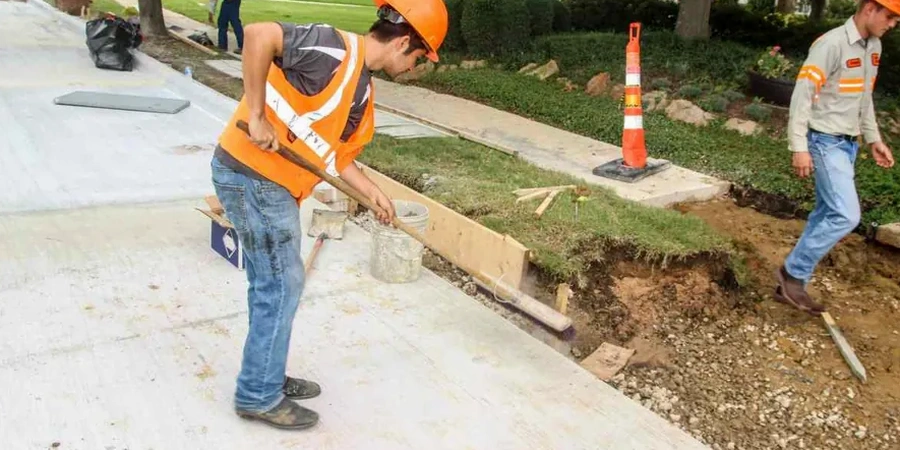
Critical ground factors in Cambridge Ontario
The biggest threat to a rigid pavement in Cambridge is not the truck axle; it is the water sitting three feet below the slab in April. The city straddles the Grand River floodplain, and parts of the industrial subdivisions near the 401 are built on compacted fill over former wetland soils. When the water table rises, the subgrade support drops, and the edge stresses on the slab can exceed the concrete's fatigue limit within the first thousand load repetitions. Pumping at joints, faulting, and corner breaks follow. We model the pavement as a plate on a Winkler foundation and run the erosion analysis from the PCA method to confirm the base layer gradation will not migrate under repeated hydraulic pressure. In areas with marginal subgrade, we sometimes recommend a cement-stabilized base to bridge the weak spring season, effectively turning the pavement structure into a composite section that keeps the joint load transfer coefficient high even when the ground underneath is saturated.
Our services
We deliver rigid pavement design packages that go from subgrade investigation to joint detailing, aligned with Ontario Provincial Standard Specifications and municipal requirements for the Cambridge area.
Jointed Plain Concrete Pavement Design
Full thickness design per AASHTO 93, including traffic load spectra, ESAL projections, and fatigue analysis for the edge stress condition. We specify dowel diameter and spacing for the expected joint load transfer.
Subgrade and Base Characterization
Field plate load tests and CBR correlations to establish the modulus of subgrade reaction (k-value). We evaluate seasonal variations and recommend geotextile separation or cement treatment when the fines content exceeds 15%.
Joint Layout and Construction Sequencing
We prepare jointing plans showing transverse and longitudinal joint locations, tie bar details, and saw-cut timing. For phased construction in active facilities, we sequence pours to minimize downtime.
Common questions
What thickness of concrete pavement do I need for a truck yard in Cambridge?
Thickness depends on subgrade support, concrete strength, and the heaviest vehicle that will use the yard. For a distribution center with fully loaded B-trains, we typically design jointed plain concrete slabs between 220 mm and 260 mm, assuming a subgrade k-value of 40–60 MPa/m and 4.5 MPa flexural strength. The AASHTO 93 equation governs the final number.
What does rigid pavement design cost for a Cambridge industrial project?
A full design package including subgrade investigation, traffic analysis, thickness calculation, and jointing plans generally ranges from CA$2,720 to CA$9,430, depending on the paved area and the required testing. Smaller yards with straightforward access fall at the lower end; larger sites needing plate load tests and seasonal groundwater monitoring move toward the upper end.
Do you consider frost heave in the design?
Yes. We use the Cambridge freeze index of approximately 400 °C-days to check the depth of frost penetration. The granular base thickness is set to prevent capillary rise and to provide a working platform, not as a frost protection layer in the traditional sense, because a rigid pavement bridges minor differential heave if the slab is properly reinforced at joints.
How do you handle the transition between asphalt and concrete pavement?
We detail a transition slab or a thickened edge at the interface to manage the differential stiffness. The concrete pavement is dowelled into the asphalt section with a smooth dowel bar embedded in the asphalt side, allowing horizontal movement while preventing vertical faulting. The detail follows OPSS 350 and the Ontario Concrete Pavement Guide.