The contrast between glacial till deposits beneath the Hespeler area and the silty clay layers typical of the Preston flats creates two fundamentally different foundation conditions within the same city limits. A soil mechanics study in Cambridge Ontario must account for this variability, because a footing design that works on the western moraine may require significant adjustment just three kilometers east. The Speed River floodplain introduces additional complexity: alluvial soils with organic lenses, high moisture content, and seasonal groundwater fluctuations that affect both bearing capacity and settlement predictions. Our laboratory sees samples from all three core Cambridge neighborhoods every month, and the range of index properties tells a story of post-glacial deposition that no single borehole can capture. For projects near the Grand River, we often combine standard penetration testing with a seismic refraction survey to map bedrock depth where the overburden exceeds fifteen meters.
Cambridge's glacial stratigraphy means two adjacent lots can have bearing capacities differing by 100 kPa — a soil mechanics study resolves that uncertainty before excavation begins.
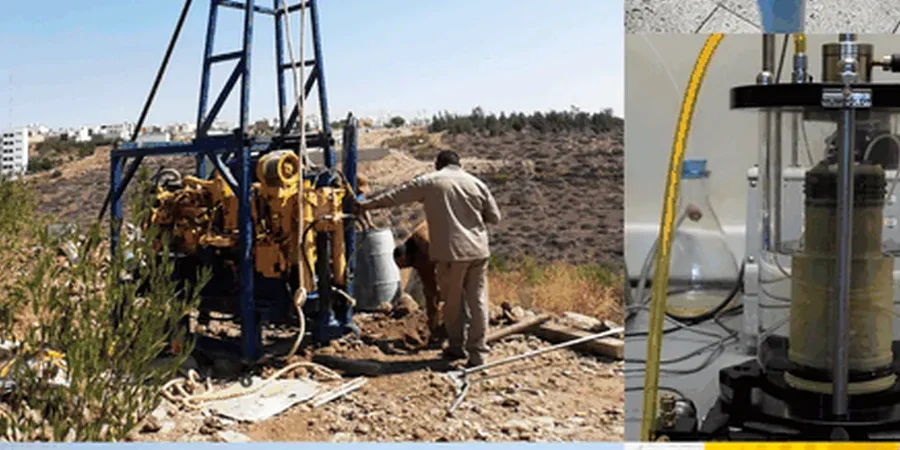
Scope of work in Cambridge Ontario
Critical ground factors in Cambridge Ontario
A six-storey residential building on a former industrial parcel along Water Street encountered a compressible silt layer at seven meters depth that had not been identified during preliminary site screening. The original design assumed a conventional spread footing system bearing on stiff till, but the soil mechanics study in Cambridge Ontario revealed a buried channel infilled with normally consolidated sediment. Without the laboratory consolidation tests and the subsequent settlement analysis, differential movement would have exceeded 40 millimeters within the first three years of service. The solution involved deepening the foundation to competent material and incorporating a structural slab designed for moderate subgrade deformation. Cambridge has numerous brownfield sites where historical fill, variable thicknesses of organics, and undocumented underground structures create geotechnical risk that only a thorough field investigation and testing program can properly define. Seismic site classification per NBCC 2020 also demands shear wave velocity data, particularly for sites underlain by soft clay where amplification effects can increase spectral accelerations by a full site class step.
Our services
Every soil mechanics study in Cambridge Ontario we perform is structured around the specific geotechnical questions the site presents. The following testing and analysis modules form the core of our investigative approach.
Index Property Testing & Soil Classification
Grain size distribution (sieve and hydrometer), Atterberg limits, natural moisture content, and organic content determination. These baseline parameters establish the USCS classification and provide the first indication of engineering behavior for Cambridge's glacial and alluvial deposits.
Shear Strength & Consolidation Analysis
Direct shear, triaxial compression (UU, CU, CD), and one-dimensional consolidation testing. Critical for foundation bearing capacity calculations, slope stability assessment along the Grand River valley, and estimating settlement magnitude and rate in compressible silts.
Compaction & Density Evaluation
Standard and Modified Proctor testing to establish moisture-density relationships for engineered fill. Paired with field density verification using nuclear gauge or sand cone methods on site, this ensures compliance with Ontario Provincial Standards for structural backfill.
Dynamic Soil Properties & Seismic Classification
Resonant column, cyclic triaxial, and bender element testing to determine shear modulus degradation and damping curves. Combined with field MASW surveys, these results support NBCC seismic site classification and liquefaction triggering analysis for Cambridge's saturated granular layers.
Common questions
How does a soil mechanics study differ from a standard geotechnical investigation in Cambridge?
A standard geotechnical investigation focuses on field exploration — boreholes, test pits, and in-situ testing — to develop a ground model and provide foundation recommendations. A soil mechanics study goes further: it involves detailed laboratory testing on undisturbed samples to measure engineering properties like shear strength, compressibility, permeability, and stiffness. This level of characterization is essential for numerical modeling, settlement analysis exceeding simple elastic methods, and projects where the cost of overconservatism or the risk of underprediction justifies a deeper understanding of soil behavior.
What laboratory tests are typically included for a Cambridge clay site?
For the glaciolacustrine clays found in parts of Cambridge, the testing program typically includes Atterberg limits, one-dimensional consolidation (oedometer) tests to determine compression and recompression indices, unconsolidated-undrained triaxial tests for short-term bearing capacity, and consolidated-undrained triaxial tests with pore pressure measurement for staged construction analysis. If the clay shows sensitivity, we may add fall cone tests and remolded shear strength comparisons to quantify potential strength loss.
Can soil mechanics testing help with basement waterproofing design in Cambridge?
Yes, indirectly but importantly. Permeability testing on undisturbed samples — either falling-head in the triaxial cell or constant-head in a rigid-wall permeameter — provides the hydraulic conductivity values needed to estimate groundwater inflow rates. Combined with the groundwater monitoring data from the site investigation, these parameters allow the structural and waterproofing designers to specify drainage systems and membrane requirements appropriate for the actual soil conditions, rather than relying on generic assumptions.
What is the typical cost range for a soil mechanics study in Cambridge Ontario?
For a comprehensive soil mechanics study in Cambridge Ontario covering index testing, shear strength, and consolidation analysis on samples from 3–5 boreholes, the laboratory testing component typically ranges between CA$4,130 and CA$6,730. The total cost depends on the number of samples, the specific tests selected, and whether dynamic properties or specialized cyclic testing are required. This range covers the laboratory program only; field drilling, sampling, and reporting are separate scope items.