Cambridge sits squarely on the Port Stanley Till—a dense, silty-clay glacial deposit that looks competent at first glance but holds enough fines to become a problem the moment water gets trapped beneath asphalt. We have seen parking lots off Hespeler Road fail within three seasons because the designer assumed a uniform subgrade, when in reality the till transitions into pockets of outwash sand near the Speed River. A reliable flexible pavement design here starts with understanding that variability, not with a standard catalogue section. Before we commit to layer thicknesses, we run in-situ density checks and Proctor tests to establish compaction targets that match the actual borrow material, and we cross-reference the results with CBR road assessments to avoid overbuilding the granular base on subgrades that are stronger than the textbook assumes. That sequence—field calibration first, structural design second—is what keeps a Cambridge heavy-duty lot from developing alligator cracking before the warranty expires.
A flexible pavement is only as good as the subgrade it rests on—and in Cambridge, that subgrade changes more often than the zoning map suggests.
Scope of work in Cambridge Ontario
Critical ground factors in Cambridge Ontario
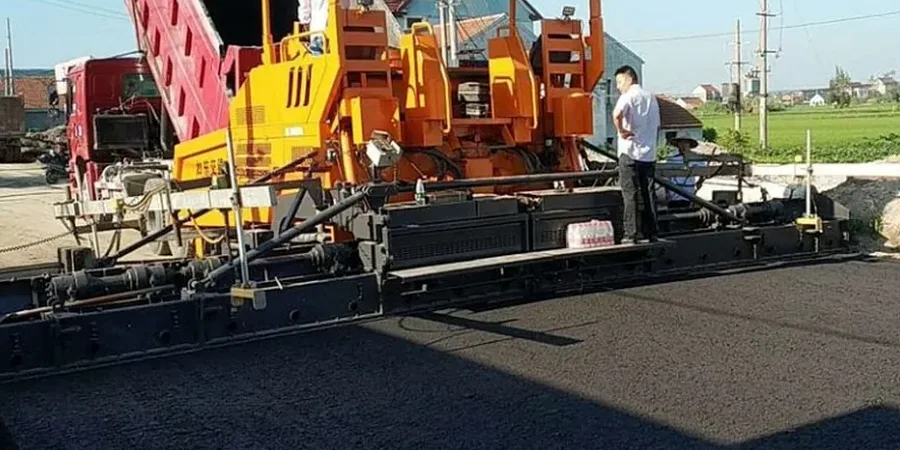
The contractor backs the vibratory smooth-drum roller off the lowboy and starts working the granular A in lifts, while the nuclear density gauge operator shadows every pass to confirm that the compaction curve is being hit before the moisture leaves the material. That operation looks routine, but on a Cambridge site underlain by silt-rich till, over-compaction can actually reduce the permeability of the sub-base and trap water at the asphalt interface—accelerating stripping and fatigue cracking from the bottom up. The bigger risk is skipping the pre-paving proof-roll with a fully loaded tandem axle truck; we have diagnosed pavement failures along Fountain Street where soft spots in the upper subgrade went undetected because the contractor relied solely on density testing without a deflection-based verification. When the pavement section is designed properly but the construction QA is reduced to a handful of nuclear gauge readings, the owner ends up with a five-year overlay instead of a twenty-year pavement, and the cost difference is never recovered.
Our services
Our flexible pavement design workflow for Cambridge projects bridges geotechnical investigation and structural pavement engineering in a single coordinated sequence. We do not hand off a generic soils report and wish the pavement designer luck—we stay involved through the layer optimization stage because the subgrade modulus inputs and the drainage assumptions need to be defended with site-specific data, not regional defaults.
Subgrade Characterization and CBR Testing
Field and laboratory CBR determinations on undisturbed and remolded samples from each distinct soil unit encountered across the Cambridge site. We correlate CBR values with resilient modulus using established MTO relationships and identify zones where subgrade stabilization—lime, cement, or mechanical blending—delivers a better lifecycle cost than thickening the granular base.
Multilayer Elastic Pavement Analysis
We build a layered elastic model using actual subgrade modulus profiles, not textbook assumptions, and iterate the asphalt and granular thicknesses to satisfy both fatigue and rutting criteria under the projected ESAL loading. The output is a pavement structure that can be tendered with confidence, because every input is traceable to a test result from the specific Cambridge property.
Construction QA and Proof-Roll Verification
On-site compaction monitoring with nuclear density gauges, coupled with proof-rolling under a loaded tandem-axle truck to detect soft zones that density testing alone misses. We document lift thicknesses, moisture contents, and deflection responses so the owner has a verifiable record that the pavement was built to the design intent.
Common questions
How much does a flexible pavement design package cost for a Cambridge commercial lot?
For a typical Cambridge commercial or light-industrial lot, the combined geotechnical investigation and pavement design package ranges from CA$2,180 to CA$6,720, depending on the number of boreholes or test pits required, the extent of laboratory CBR and Proctor testing, and whether a multilayer elastic analysis is needed versus an empirical AASHTO design. A site with uniform Port Stanley Till and moderate truck traffic sits at the lower end; a site with variable fill, high ESALs, and frost-depth analysis moves toward the upper end.
What makes flexible pavement different from rigid pavement in the Cambridge climate?
Flexible pavement distributes wheel loads through a layered system where the asphalt surface, granular base, and subgrade all contribute structurally, while rigid pavement relies on the flexural strength of a concrete slab. In Cambridge, flexible pavements are more forgiving of the seasonal volume changes that occur in the silty till subgrade—they can accommodate minor differential movement without the uncontrolled cracking that affects jointed concrete. The trade-off is that flexible pavements require more diligent drainage design to prevent spring-thaw weakening, and the asphalt surface needs periodic mill-and-overlay cycles that rigid pavements defer longer.
Do you handle both the geotechnical investigation and the pavement thickness design?
Yes—we perform the entire sequence under one scope: subsurface investigation, laboratory testing for CBR and Proctor, subgrade modulus characterization, and the multilayer pavement analysis. This avoids the common disconnect where a geotechnical consultant provides a report and a separate pavement engineer designs from assumed parameters. Our Cambridge projects benefit from continuity because the same team that logged the boreholes is interpreting the modulus values that drive the layer thicknesses.
What is the typical pavement structure for a Cambridge industrial access road?
For a Cambridge industrial access road carrying moderate to heavy truck traffic—say 1 to 3 million ESALs over 20 years—a typical structure might be 120 mm of HL8 surface course over 100 mm of HL4 binder course, on 300 mm of Granular A base and 300 mm of Granular B sub-base, placed on a compacted select subgrade with a minimum resilient modulus of 30 MPa. However, that section must be verified against the actual subgrade conditions; a site underlain by clean outwash sand may need less granular thickness but more attention to frost protection, while a site on soft silt may require subgrade stabilization or a thicker aggregate layer to meet the same design life.