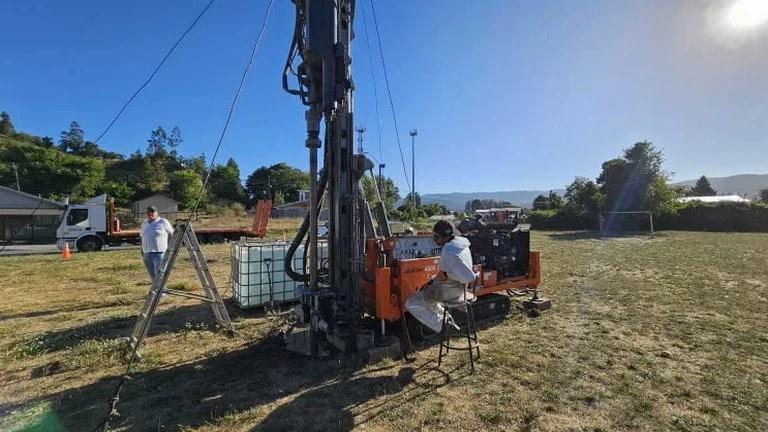
A 20-tonne tracked excavator with a 600 mm wide bucket cuts through the overburden near the Speed River, opening a trench that exposes exactly what sits beneath the proposed foundation footprint in Cambridge. The exploratory test pit is still the most direct method for examining subsurface conditions where access permits, and in a city built on glacial till, outwash deposits, and pockets of man-made fill dating back to the original Galt, Preston, and Hespeler settlements, visual inspection of the actual strata often reveals details that borehole samples can miss. Our team coordinates with local utility locators before mobilization, because Cambridge has a dense network of buried infrastructure in older neighborhoods like West Galt and Hespeler Village, and unexpected strikes during excavation carry project-delay costs that owners cannot afford. SPT drilling complements the investigation when test pits cannot reach design depth due to groundwater or trench stability limits, and grain size analysis on samples collected directly from the pit wall refines the Unified Soil Classification for foundation design parameters.
Direct visual inspection of glacial till and outwash contact zones in Cambridge test pits often identifies buried organic layers and undocumented fill that conventional boreholes can completely miss.
Scope of work in Cambridge Ontario
Critical ground factors in Cambridge Ontario
Winter conditions in Cambridge create a narrow window of opportunity for test pit investigations—frozen ground from December through March adds excavation hours and can mask soil moisture conditions that are critical for compaction and bearing assessments the following spring. Conversely, heavy rainfall events during April and November saturate the upper granular soils across the Preston area, causing pit wall sloughing in sandy outwash that forces the crew to lay back slopes more aggressively than planned, increasing the disturbed footprint and restoration costs. Undocumented fill is the single most common geotechnical surprise in Cambridge’s older industrial corridors along Eagle Street and Dundas Street, where decades of building demolition, buried foundations, and backfilled basements create artificial ground with unpredictable compressibility and contamination potential. An exploratory test pit that encounters ash, brick fragments, or hydrocarbon staining triggers the sampling protocol for environmental screening, and the field log immediately flags the material as suspect fill requiring controlled removal or specialized foundation detailing. Skipping this investigation stage in redevelopment zones leaves the structural engineer without the site-specific data needed to design footings on variable ground.
Our services
Every exploratory test pit program in Cambridge is tailored to the specific development stage and site access constraints. The following service components cover the typical scope required by municipal building officials and consulting structural engineers across Waterloo Region.
Standard Exploratory Test Pit
Machine-excavated trench to 3.5–4.5 m depth with full stratigraphic logging, Munsell color notation, in-situ density testing, and photographic documentation of each exposed face. Suitable for single-family residential and light commercial foundation investigations.
Fill Material Characterization
Targeted test pits in redevelopment zones where historical fill is suspected. Includes visual screening for debris and contamination indicators, selective sampling for laboratory grain size and Atterberg limits, and recommendations for overexcavation or engineered fill replacement.
Bearing Capacity Verification
Test pit excavation to proposed footing elevation with hand penetrometer or pocket shear vane testing on the exposed bearing surface. Direct observation of the founding stratum allows confirmation of presumptive bearing values before concrete placement.
Percolation and Drainage Assessment
Test pits positioned at proposed infiltration facility locations, with falling-head percolation testing conducted directly in the pit floor. Logging identifies restrictive layers that would limit stormwater infiltration performance under SWM criteria.
Common questions
How deep can an exploratory test pit go in Cambridge soils?
Most test pits in the Cambridge area reach between 3.0 and 4.5 meters depth with a standard tracked excavator. The practical limit is set by trench stability in the native soil—loose sand and soft clay require sloped or benched walls that widen the excavation footprint significantly beyond 4 meters. For depths exceeding 4.5 meters, or where groundwater is encountered within the excavation zone, we typically recommend supplementing the test pit program with SPT drilling or CPT soundings to characterize deeper strata safely.
What does an exploratory test pit investigation cost in Cambridge?
A typical exploratory test pit program in Cambridge ranges from CA$660 to CA$1,160 per pit, depending on depth, access conditions, and whether laboratory testing is included. The cost covers utility locates coordination, excavator and operator time, field logging by a geotechnical technician, sample collection, and a written report with stratigraphic logs and foundation recommendations. Sites requiring traffic control, confined access, or multiple pits receive a project-specific quote after the initial site walk.
Do I need a geotechnical engineer on site during test pit excavation?
Ontario Building Code Section 4.2 requires that foundation investigations be carried out under the direction of a qualified professional, but the field logging is typically performed by an experienced geotechnical technician who follows the engineer’s investigation plan. The responsible engineer reviews all field logs, photographs, and laboratory data before issuing the final geotechnical report. On complex sites with marginal bearing conditions or suspected contamination, the engineer may attend during excavation to make real-time decisions on sampling depths and pit termination criteria.