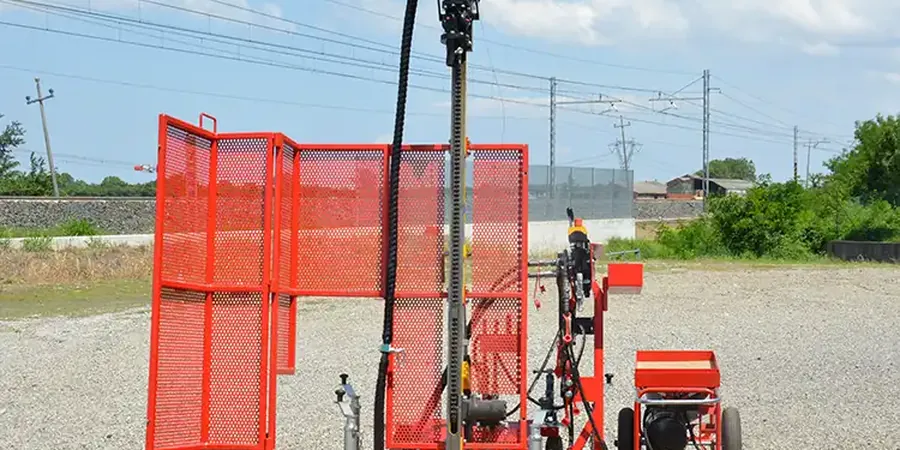
A CME-75 drill rig mobilizes to the site, its 140-pound safety hammer hoisted to a consistent 30-inch drop. In Cambridge, where the landscape shifts from the Speed River floodplain to the glacial till uplands of North Dumfries, that standardized impact is non-negotiable. Our team runs the split-spoon sampler through the hollow-stem auger, counting every blow across three consecutive 6-inch increments. The sum of the last two gives you the N-value, a number that dictates bearing capacity and settlement potential before a single footing is poured. Because the subsurface here can transition from loose alluvial silts to dense Halton Till within a few vertical feet, we often pair the SPT with a grain-size analysis to verify the stratigraphy against our field logs, ensuring the geotechnical model matches what the sampler actually retrieved from each test interval.
A properly executed SPT in Cambridge's Halton Till provides a direct, repeatable N-value that anchors the entire foundation design under NBCC Part 4.
Scope of work in Cambridge Ontario
Critical ground factors in Cambridge Ontario
Under Ontario Building Code Division B, Part 4, the geotechnical investigation must characterize the site to a depth where stress increase is less than 10% of the existing overburden pressure. In Cambridge, this often means penetrating through the stiff Halton Till into the underlying bedrock of the Salina Formation. Stopping the SPT too early, say at 15 feet because the N-values hit refusal, can miss a buried valley filled with softer glaciolacustrine clay that the till cap conceals. We have seen projects on the east side of the Grand River where a dense till layer overlies a 10-foot pocket of soft clay with an undrained shear strength below 25 kPa. That hidden weakness, if undetected, becomes a differential settlement problem that shows up within the first three years of service. Our field geologist logs every sampler increment, and if material changes unexpectedly, we extend the borehole depth until the bearing stratum is unequivocally confirmed. For structures classified as post-disaster buildings under NBCC, we also run SPT-based liquefaction triggering analyses using the NCEER methodology, reporting the factor of safety at each critical depth.
Our services
Every SPT program we run in Cambridge includes the field execution plus the supporting lab work that transforms raw blow counts into design parameters. Here is what our accredited team delivers as standard:
Standard Penetration Test with Split-Spoon Sampling
Mobile drill rig mobilized to your Cambridge site; SPT performed every 5 feet in 6 to 8-inch hollow-stem augers; N-values recorded on the field log with sample recovery, groundwater depth, and drilling notes per ASTM D1586.
Laboratory Classification of Recovered Samples
Split-spoon samples transported under chain-of-custody to our ISO 17025 lab; grain-size distribution (sieve and hydrometer), Atterberg limits, and visual-manual classification per ASTM D2488 to confirm field stratigraphy.
Liquefaction Screening and N60 Reporting
Energy-corrected N60 and overburden-corrected N1(60) values calculated for each test depth; liquefaction factor of safety computed for Cambridge sites within Grand River floodplain using SPT-based NCEER procedure.
Common questions
How much does an SPT investigation cost for a typical Cambridge residential lot?
For a standard single-family lot in Cambridge, a two-borehole SPT program with hollow-stem auger drilling to 20 feet typically ranges from CA$740 to CA$1,160. The final cost depends on access conditions, depth to bedrock, and the number of samples requiring lab classification. We provide a fixed-price proposal after reviewing the site address and your building permit requirements.
How deep do you need to drill SPT boreholes for a foundation in Cambridge?
We follow the Ontario Building Code requirement to investigate to a depth where the net stress increase is less than 10% of the existing effective overburden pressure. For a typical two-story structure on a spread footing in Cambridge's Halton Till, that usually means 20 to 25 feet. If the SPT encounters a softer layer at depth, we extend the boreholes until we hit a competent bearing stratum or bedrock.
What is the difference between raw N-value and N60?
The raw N-value is the total blow count recorded in the field with the specific hammer, rod length, and borehole diameter used on your Cambridge site. N60 corrects that raw number to 60% of the theoretical free-fall energy, accounting for hammer efficiency. Without this correction, two rigs testing the same soil can report different numbers. We measure hammer energy ratio and report both the raw N and the energy-corrected N60 on every log.
Can you use SPT data to check if my Cambridge site has a liquefaction risk?
Yes. For sites within the Grand and Speed River floodplains, we run SPT-based liquefaction triggering analyses following the NCEER/Youd and Idriss procedure. This uses the normalized N1(60) value and the fines content from lab testing to calculate the cyclic resistance ratio. The output is a factor of safety against liquefaction at each depth, which your structural engineer uses to decide on ground improvement or deep foundations.