Geotechnical site investigation in Cambridge, Ontario, forms the critical foundation layer for any construction or civil engineering project across this region of Waterloo. This category encompasses the systematic collection and interpretation of subsurface data—soil stratigraphy, groundwater conditions, bedrock depth, and geotechnical parameters—that directly informs foundation design, slope stability assessments, and excavation planning. In a city where glacial activity has deposited a complex sequence of till, outwash sands, and lacustrine silts over limestone and dolostone bedrock, understanding what lies beneath the ground surface is not merely a regulatory checkbox but a fundamental engineering necessity. Without thorough investigation, projects risk costly delays, structural distress, or even catastrophic failure.
The local geology of Cambridge is dominated by Quaternary deposits left by the retreat of the Wisconsinan ice sheet. The Port Stanley Till forms a widespread, silty-clay mantle with varying consistency, often underlain by stratified sand and gravel aquifers that connect to the Grand River watershed. Bedrock, part of the Guelph and Salina formations, can be encountered at depths ranging from a few metres in the eastern parts of the city to over 30 metres near the river valleys. This variability means that a one-size-fits-all approach to investigation is ineffective. Techniques such as the CPT (Cone Penetration Test) provide continuous profiling of soil behaviour and are particularly valuable in the soft to stiff clays and loose sands common in the Hespeler and Preston areas, where traditional sampling methods may miss thin, sensitive layers.
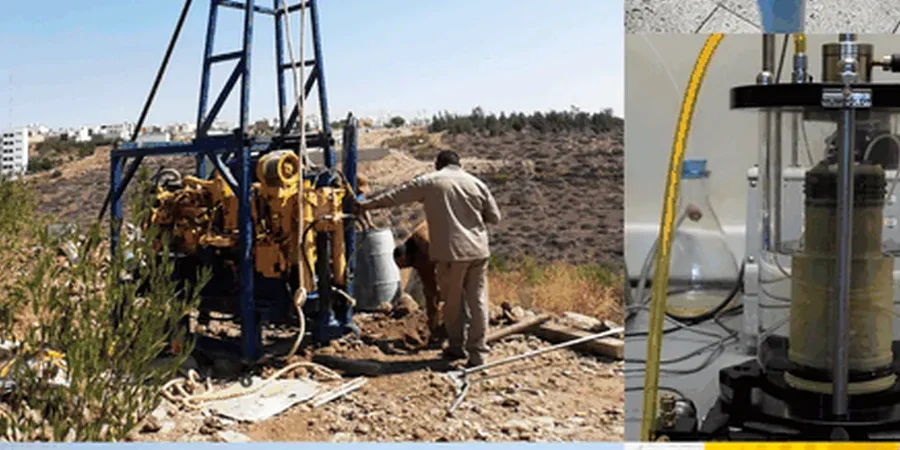
Regulatory compliance in Ontario is governed primarily by the Ontario Building Code (OBC), which references the Canadian Foundation Engineering Manual and CSA standards. The OBC mandates that every building permit application be supported by a geotechnical report prepared by a qualified professional engineer licensed in the province. This report must demonstrate adequate bearing capacity, address frost protection, and confirm stability against sliding and overturning. For environmental aspects, the Environmental Protection Act and Ontario Regulation 153/04 (Records of Site Condition) come into play when contamination is suspected or when a change in land use is proposed. A robust investigation program ensures that these regulatory requirements are met from the outset, preventing permit delays and legal liabilities.
The types of projects that demand comprehensive geotechnical investigation in Cambridge span from low-rise residential subdivisions in the growing Blair and Galt neighbourhoods to major infrastructure works such as the Highway 401 expansion and the Cambridge West Business Park. Industrial facilities, stormwater management ponds, and deep excavations for underground parking structures all rely on accurate subsurface models. Even smaller-scale additions and retaining walls can trigger the need for a targeted investigation, especially where soft organic soils or high groundwater tables are suspected. The integration of in-situ testing with laboratory analysis on undisturbed samples provides the parameters—undrained shear strength, consolidation characteristics, and hydraulic conductivity—that structural engineers need to optimize their designs safely and economically.
Available services
Common questions
What is the typical depth of a geotechnical investigation for a residential building in Cambridge?
For a single-family dwelling, boreholes typically extend to a minimum depth of 3 to 5 metres below the proposed footing elevation, or until competent bearing stratum is confirmed. In Cambridge's glacial till areas, this often means penetrating through weathered surficial clays into the underlying dense Port Stanley Till. If bedrock is shallow, coring may be required to prove its integrity.
How are groundwater conditions addressed during a site investigation in the Waterloo Region?
Groundwater monitoring wells are installed in completed boreholes to measure static water levels and assess seasonal fluctuations. In Cambridge, perched water tables within sand lenses are common and must be identified to prevent excavation instability. Long-term monitoring data guides dewatering system design and helps satisfy Grand River Conservation Authority requirements for projects near surface water features.
What is the difference between a geotechnical investigation and an environmental site assessment?
A geotechnical investigation focuses on the physical and mechanical properties of soil and rock for structural design purposes, while an environmental site assessment evaluates potential contamination. In Ontario, both are often required under O. Reg. 153/04 for redevelopment projects. The two disciplines frequently share borehole drilling but analyze samples for different parameters—strength versus chemical composition.
When is a deep foundation investigation required instead of a shallow one in Cambridge?
A deep foundation investigation involving techniques like the CPT test becomes necessary when shallow soils exhibit low bearing capacity, high compressibility, or when thick deposits of organic silt and peat are encountered—common in the floodplain areas along the Speed and Grand Rivers. The investigation must extend deep enough to characterize the pile bearing layer, often reaching the competent bedrock or dense till at depth.