Ground improvement in Cambridge, Ontario, encompasses a suite of geotechnical techniques designed to enhance the engineering properties of soil and rock to support safe, durable construction. This category is critical because much of the region is underlain by complex glacial deposits that often lack the strength or stiffness required for modern infrastructure. Whether it's for residential subdivisions, commercial warehouses, or municipal roadways, improving the ground reduces long-term settlement, increases bearing capacity, and mitigates liquefaction risks. By applying methods like stone column design or vibrocompaction design, engineers can transform marginal sites into buildable land without the cost and carbon footprint of deep foundations or soil replacement.
The local geology of Cambridge is dominated by the legacy of the last glaciation, which left behind a varied stratigraphy of till, glaciofluvial sands, and glaciolacustrine silts and clays. The Waterloo Moraine, a significant regional aquifer, introduces layers of loose to compact sands that can be prone to densification under seismic or vibratory loads. In the Hespeler and Galt areas, pockets of soft, compressible clay and organic silts are common in low-lying zones near the Grand and Speed Rivers. These conditions demand a tailored ground improvement strategy, as uniform soil behavior cannot be assumed even across a single development parcel.
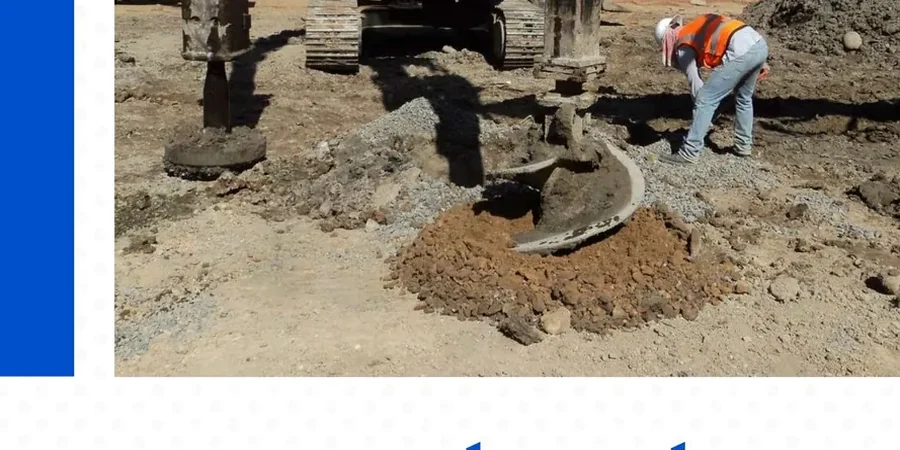
Canadian practice for ground improvement is governed by national standards, primarily CSA A23.1 for concrete materials, CSA S6 for bridge and highway structures, and the Canadian Foundation Engineering Manual, which provides design guidance aligned with the National Building Code of Canada. In Ontario, the Ministry of Transportation's OPSS.MUNI 206 specification for granular materials and the Ontario Building Code's Part 4 structural design provisions are directly relevant. Geotechnical investigations must follow ASTM D1586 for standard penetration testing and CSA A23.2 for material testing, while performance verification often relies on post-treatment cone penetration testing per ASTM D5778. These standards ensure that techniques like vibrocompaction design meet rigorous settlement and bearing capacity criteria.
The types of projects that routinely require ground improvement in Cambridge range from light industrial buildings on the city's expanding eastern fringe to infrastructure upgrades along Highway 24. Low- to mid-rise residential developments over soft clay deposits often benefit from stone column design to control differential settlement, while large-footprint retail centers and logistics hubs on loose granular soils use vibrocompaction to achieve uniform density. Municipal applications include approach embankments for bridges and water retention ponds where seepage control and stability are paramount. In each case, the goal is to create a reliable, predictable foundation medium that avoids costly delays and future remediation.
Available services
Common questions
What is ground improvement and when is it necessary in Cambridge, Ontario?
Ground improvement refers to a range of techniques that modify in-situ soils to increase bearing capacity, reduce settlement, or mitigate liquefaction. In Cambridge, it becomes necessary when site investigations reveal loose sands, soft clays, or uncontrolled fill that cannot safely support proposed structures under the Ontario Building Code's serviceability limits.
How do local soil conditions in Cambridge influence the choice of ground improvement method?
Cambridge's glacial geology creates a patchwork of loose granular soils and compressible silty clays, especially near the Grand River. Loose sands respond well to vibrocompaction, while soft cohesive soils often require stone columns to provide drainage and reinforcement, making the stratigraphic profile the key driver in method selection.
What Canadian standards regulate ground improvement design and testing?
Design is guided by the Canadian Foundation Engineering Manual and relevant parts of the National Building Code of Canada, with Ontario-specific provisions in the Ontario Building Code. Testing follows CSA and ASTM standards, including ASTM D1586 for penetration resistance and ASTM D5778 for post-treatment cone penetration verification.
Can ground improvement eliminate the need for deep foundations on poor soils?
Yes, in many cases ground improvement can replace deep foundations by creating a competent, reinforced soil mass that distributes loads over a larger area. This approach is often more economical and faster than piling, provided the improved ground meets the project's settlement and bearing requirements under local regulatory criteria.